
Showing posts with label artists. Show all posts
Showing posts with label artists. Show all posts
Tuesday, April 10, 2007

Monday, April 9, 2007
Meat of Tomorrow
 Thinking about Kelly's project, I found this:
The Meat of Tomorrow, by James King, explores the implications of an impending technology that will soon allow edible meat to be grown in vitro from a small sample of animal tissue, rendering the inefficiencies, cruelties, traditions, and livelihoods of livestock farming unnecessary.
Saturday, March 31, 2007
chocolate Jesus

LINK: "A planned Holy Week exhibition of a nude, anatomically correct chocolate sculpture of Jesus Christ was canceled Friday amid complaints from Catholics, including Cardinal Edward Egan... Artist Cosimo Cavallaro is best known for his quirky work with food. Past efforts include repainting a Manhattan hotel room in melted mozzarella, spraying five tons of pepper jack cheese on a Wyoming home and festooning a four-poster bed with 312 pounds of processed ham".
Wednesday, March 7, 2007
Rauschenberg in the news

review of a Rauschenberg exhibit in the NY Times:
Images of Hubert H. Humphrey, Barry Goldwater, Malcolm X, the Apollo 7 astronauts, Army helicopters and civil rights protesters establish Mr. Rauschenberg’s interests: politics, the space race, the war in Vietnam, the plight of black Americans. Abraham Lincoln, the Great Emancipator, appears several times. Men in suits bespeak entrenched authority. President Richard M. Nixon lines up with the members of his cabinet; their wives cluster around his. Sprinkled at the margins of the group portraits are the faces of black and white football players (including O. J. Simpson) and the regimented rows of a high school yearbook.
Wednesday, February 14, 2007
box art
MEMENTO BOX by Cati Vaucelle: I designed this interactive box as an attractive passage from door to space . The door leads to my souvenirs and is always slightly opened . A bright light shines in the back of the box clarifying a few objects and pictures around it . However, whenever my hand tries to grab what captures the eye, the door closes onto my hand and all is dark again . Whenever I go away for a tiny bit, the door opens up and more lights shine into some parts of my souvenirs and I can travel though them from far away
Monday, February 12, 2007
art + marriage
-Seven Years of Love As Art See also: Seven Year Weddings in Seven Years
-The above project was inspired in part by a previous work by Linda Montano and Tehching Tsieh called The Year of the Rope
-Tim Miller : Glory Box
-wedding at the MoMA
-In the Charles Perrault fairy tale, Peau d'Ane, a young princess orders impossible wedding gifts from her stepfather in order to avoid marrying him: three dresses made of immaterial materials. Valérie Lamontagne is working on three wearables projects based on this story. The three Peau d'Ane dresses will translate the qualities of the sky, moon and sun within various geographical locations at all times of the day. Read more about the meteorologically modulated dresses
-non-weddings, a net art project
- Yoko Ono & John Lennon, Bed-in
- Design Interactions/Love + Commitment: WMMNA review
WRITING:
essay about Voltairine de Cleyre
Emma Goldman - Marriage and Love
Mary Wollstonecraft - A Vindication of the Rights of Woman, 1792
-The above project was inspired in part by a previous work by Linda Montano and Tehching Tsieh called The Year of the Rope
-Tim Miller : Glory Box
-wedding at the MoMA
-In the Charles Perrault fairy tale, Peau d'Ane, a young princess orders impossible wedding gifts from her stepfather in order to avoid marrying him: three dresses made of immaterial materials. Valérie Lamontagne is working on three wearables projects based on this story. The three Peau d'Ane dresses will translate the qualities of the sky, moon and sun within various geographical locations at all times of the day. Read more about the meteorologically modulated dresses
-non-weddings, a net art project
- Yoko Ono & John Lennon, Bed-in
- Design Interactions/Love + Commitment: WMMNA review
WRITING:
essay about Voltairine de Cleyre
Emma Goldman - Marriage and Love
Mary Wollstonecraft - A Vindication of the Rights of Woman, 1792
Tuesday, February 6, 2007
Christy Georg
 Christy Georg makes body extensions, instruments, and sculpture incorporating audio, but she does not always use them in the presence of other people. One example is this piece called "Monitoring the Dunes" at White Sands National Park in 2005.
 The “monitor” and her instrument caseare in white, blending in to the environs. The instrument is unpacked and assembled on site in the dunes. It consists of two large stethoscopes, which press against the sand and connect to the monitor’s earphones via tubing. This device is housed in tall forearm crutches, so that when in use, the monitor pulls her body off the earth, and only her ears (via their extensions) are connected to the earth. The monitor’s endurance determines her ability to sonically monitor the dunes.
Monday, February 5, 2007
I always had this idea that doing art was just a masturbatory activity, and didn't really help anybody.
 Interviewer: What led you to become an artist?
JB: I always had this idea that doing art was just a masturbatory activity, and didn't really help anybody. I was teaching kids in the California Youth Authority, an honor camp where they send kids instead of sending them to prison. One kid came to me one day and asked if I would open up the arts and crafts building at night so they could work. I said, "If all of you guys will cool it in the classes, then I'll baby-sit you." Worked like a charm. Here were these kids that had no values I could embrace, that cared about art more than I. So, I said, "Well, I guess art has some function in society," and I haven't gotten beyond that yet, but it was enough to convince me that art did some good somehow. I just needed a reason that wasn't all about myself.
LINK TO MP3 CONVERSATION WITH BALDESSARI AT THE HIRSCHHORN MUSEUM, DC
Art & Art History department lecture: Heather McGuire on John Baldessari
Wednesday, Feb 7th, Library 321, 4:30
Heather McGuire was graduated from the University of Virginia (B.A. English) and VCU (B.F.A. Crafts). She worked as a curatorial assistant on the Hirshhorn's Visual Music exhibition and curated several gallery shows in Richmond, VA. She is currently pursuing her doctorate in Art History at VCU and beginning her dissertation on John Baldessari's Blasted Allegories. Visit http://www.1708gallery.org/ and click on Exhibitions: Current for a show of contemporary artists that Heather curated.
Saturday, February 3, 2007
So, Why Is this Art?
 The Walker Art Center in Columbus, Ohio, has a great collection of works and info for those who might be asking: SO, WHY IS THIS ART?
Their resources include background on work by Gabriel Orozco and Adrian Piper, as well as this piece by Jana Sterbak, a dress made out of meat.
Friday, February 2, 2007
Head Room
 from German group Bilderwerfer
7 hosts -- with very different backgrounds except for the city they live in -- stage 7 interventions in a public space in the city. Through the use of a Head Room home box, a box covering their heads yet leaving their bodies visible, they invite one person for a face to face conversation.
This home box, designed by architect Stephane Derveaux, is not just a box, but a reproduction of the hosts’ favourite room in their own houses. The Head Room, from this perspective, balances on the edge between so called private and public space.
The hosts themselves -- an artist, a shopkeeper, a scholar, a worker -- decide who to invite. The conversations they engage in are not interviews. There are no specific questions that need to be answered. It is in the first place about the actual experience of being in the Head Room, its performative aspect, the feelings and reflections it brings about. The Head Room home boxes, the hosts and their conversations are brought back to the project’s base camp -- the Head Room of the project -- located at the platform China studio in the 798 factory. Every box adds another “room” to the installation that is being created as the interventions proceed.
Wednesday, January 31, 2007
links from Lance Winn
These are some of the artists and projects that Lance Winn mentioned during our group discussion. Some others are linked on the side bar under "Artists".
Valie Export

Tap and Touch Cinema, 1968, in which the artist, a box attached to her naked chest, invited pedestrians in several European cities to “visit the cinema”.
Gabriel Orozco

Yielding Stone is a large ball clay that was rolled down city streets in 1992, making impressions in the ball and collecting various debris. The ball ultimately weighed as much as Orozco himself.
Manet's Olympia and the Gaze

objectification and the male gaze
Bruce Nauman

Wall-Floor Positions, 1968. Making himself into a "minimalist" prop sculpture in the manner of Richard Serra, Nauman moves through various poses in realtion to the floor and wall. While other sculptors were using wood planks, pieces of lead, or sheets of steel, Nauman uses his body to explore the space of the room, turning it into a sort of yardstick to investigate and measure the dimensions of the space.
The Uncanny - essay by Sigmund Freud
Sigmund Freud described the uncanny as ‘a hidden, familiar thing that has undergone repression and then emerged from it’.
U.S. artist Mike Kelley curated a show about The Uncanny that explores memory, recollection, horror and anxiety through the juxtaposition of a highly personal collection of objects with realist figurative sculpture.
Valie Export

Tap and Touch Cinema, 1968, in which the artist, a box attached to her naked chest, invited pedestrians in several European cities to “visit the cinema”.
Gabriel Orozco

Yielding Stone is a large ball clay that was rolled down city streets in 1992, making impressions in the ball and collecting various debris. The ball ultimately weighed as much as Orozco himself.
Manet's Olympia and the Gaze
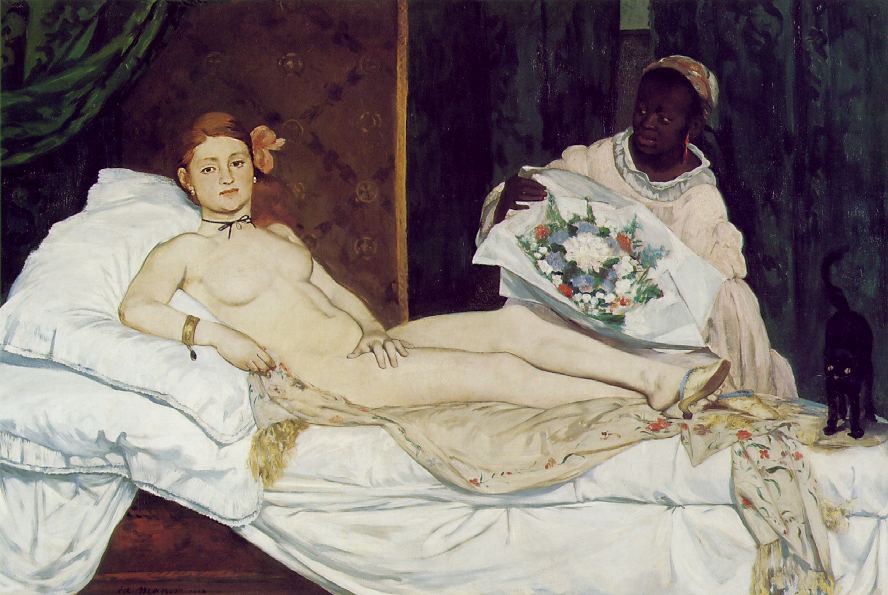
objectification and the male gaze
Bruce Nauman

Wall-Floor Positions, 1968. Making himself into a "minimalist" prop sculpture in the manner of Richard Serra, Nauman moves through various poses in realtion to the floor and wall. While other sculptors were using wood planks, pieces of lead, or sheets of steel, Nauman uses his body to explore the space of the room, turning it into a sort of yardstick to investigate and measure the dimensions of the space.
The Uncanny - essay by Sigmund Freud
Sigmund Freud described the uncanny as ‘a hidden, familiar thing that has undergone repression and then emerged from it’.
U.S. artist Mike Kelley curated a show about The Uncanny that explores memory, recollection, horror and anxiety through the juxtaposition of a highly personal collection of objects with realist figurative sculpture.
Adrian Piper
Adrian Piper, Performance, Catalysis III, 1970

Adrian Piper, Performance, Catalysis IV, Frozen Speech, 1970

From the New Museum website: Marking her first explorations in spontaneous and unannounced performance, in 1970, Piper embarked on her seminal Catalysis series in which she physically transformed herself into an odd or repulsive person and went out in public to experience the frequently disdainful responses of others. These explorations into xenophobia involved such activities as covering her clothing with sticky, wet paint while shopping at Macy's. Though photographs are all that remain of the Catalysis series, the work itself focused on the interaction between the artist and the public, and more specifically, on the reaction of the individual to Piper's presence.

Adrian Piper, Performance, Catalysis IV, Frozen Speech, 1970

From the New Museum website: Marking her first explorations in spontaneous and unannounced performance, in 1970, Piper embarked on her seminal Catalysis series in which she physically transformed herself into an odd or repulsive person and went out in public to experience the frequently disdainful responses of others. These explorations into xenophobia involved such activities as covering her clothing with sticky, wet paint while shopping at Macy's. Though photographs are all that remain of the Catalysis series, the work itself focused on the interaction between the artist and the public, and more specifically, on the reaction of the individual to Piper's presence.
Friday, January 19, 2007


Wednesday, January 17, 2007
Subscribe to:
Posts (Atom)